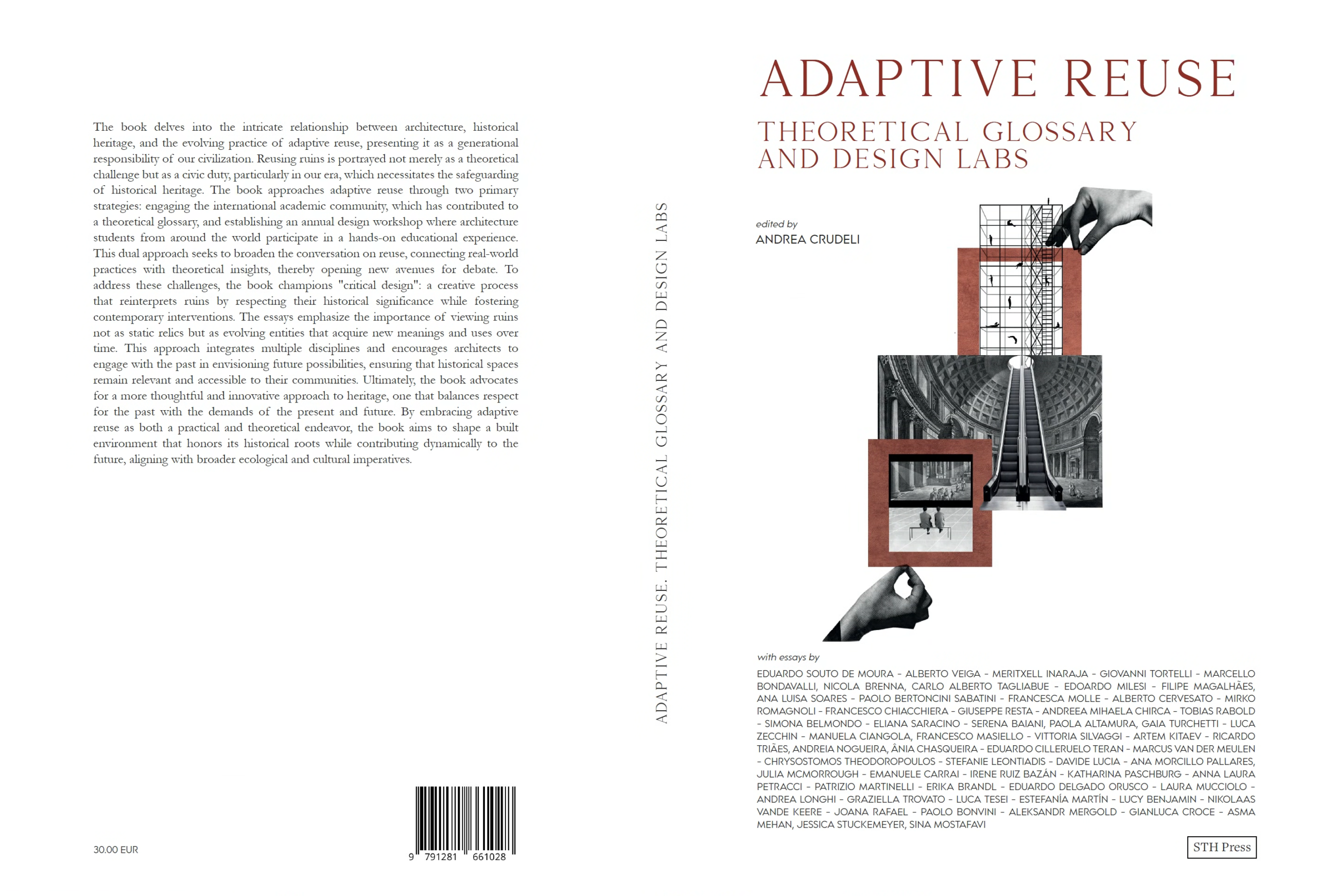
Adaptive Reuse. Theoretical Glossary and Design Labs
Edited by Andrea Crudeli
The book delves into the intricate interplay between architecture, historical heritage, and the evolving practice of adaptive reuse, presenting it as a generational responsibility for our civilization. It frames the reuse of ruins not merely as a theoretical challenge but as a civic duty, particularly in a time that calls for the preservation of historical heritage.
Addressing adaptive reuse through two main strategies, the book engages the international academic community, contributing to a theoretical glossary, and fosters global participation through an annual design workshop for architecture students. This dual approach bridges theoretical discourse with practical trends, opening new avenues for debate.
The book advocates for “critical design,” a creative process that respects the historical significance of ruins while promoting contemporary interventions. It underscores the idea that ruins are not static relics but dynamic entities capable of evolving, creating new meanings and uses. By integrating diverse disciplines, architects are encouraged to engage with the past to envision futures where historical spaces remain relevant and accessible to communities.
Ultimately, the book champions a thoughtful, innovative approach to heritage—one that balances reverence for the past with the demands of the present and future. Through adaptive reuse, the aim is to shape a built environment that honors historical roots while dynamically contributing to the future, aligned with broader ecological and cultural imperatives.
ISBN (paperback): 9791281661028
Language: English
Dimensions: ISO A5
Pages: 250